SBS 2011 Standard : Exchange 2010 Single Message Restore

sbsstdDuring a recent SMB MVP Community Roadshow event in Edinburgh, a member of the audience asked us about Email restore in SBS 2011.

Although i knew this could be done, i had never actually done it. So i decided to work out how it was done with SBS 2011.

I found a lot of great resources online that helped me with the process and i have linked to them at the end of this post.

I’m focusing on a situation where we are restoring from a backup, rather than what is available through the Exchange dumpster (aka Recover Deleted Items) although i do cover that briefly below.

Read more of this post

Quick Fix: AFD.sys / AFD Service is missing Windows XP

I had a customer email me yesterday with the following symptoms…

Symptoms

This particular client is located in France, so a site visit is a little tricky. Luckily they had a second computer, and we could talk through Skype. I did some basic connectivity tests like ipconfig, the IP was reported as 0.0.0.0 with a subnet mask of 0.0.0.0. Read more of this post

SBS 2011 Essentials Log Collector RTM

sbsessThe SBS 2011 Essentials Log Collector tool has finished its beta test and is now available as an RTM Download.

The download is available as an MSI, or as an Add-in for SBS Essentials in WSSX format. The cool thing about using the Add-in on the server is it will automatically push out the Log Collector out to any client machine you have connected on the network.

The Log Collector is really simple to use, and will take a lot of the Read more of this post

Quick Fix : Did I Update or Did I Not Update, that is the question!

powershell2xa4I currently have a number of books on my desk that i use for reference, you may have heard of them, read them, bought them, stolen them, sorry, borrowed them etc, Anyway they wont be a new idea to you, i don’t mean books in general i mean these particular books. I am of course referring to the Administrators Pocket Consultant series from Microsoft Press.

All of them unnervingly seem to be written by the same person, Mr William R Stanek. Anyway there is a point to this.

I have been answering questions in the forum recently and i find myself asking the OP, hey do you have XYZ update installed?

They usually reply, how do i check?

Of course i refer them to their Administration journal, which clearly shows the date and time any update had passed testing and was approved for installation, the name of the tech who logged onto the server, the colour of his socks he had on whilst he installed it. Of course it could have been a her.

Knowing many of you don’t keep such a journal only saddens me, i like to know what colour socks i had on, on a given day and i frequently go back and check.

I turned of course to my PowerShell Administrators Companion, and found the following command.

Never again shall you be left red faced by the question, do you have XYZ update installed? Not only will you be able to answer with confidence, you will be able to give all sorts of other detail that will really impress me.

Loading up PowerShell, you can simply type…

Get-Hotfix

get-hotfix

This will list all of the Updates, Hotfixes and Service Packs that have been installed onto the system, it will also list the date, and who installed them.

But how does that help you find a specific update? Simply add the KB number you are looking for.

Get-Hotfix –id <KB Number>

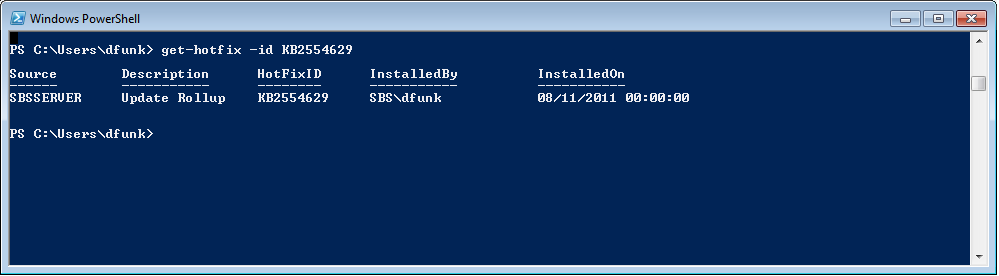
For example if i want to know if i have installed SBS Essentials Update Rollup 1, i can type..

Get-Hotfix –id KB2554629

get-hotfix-ur1

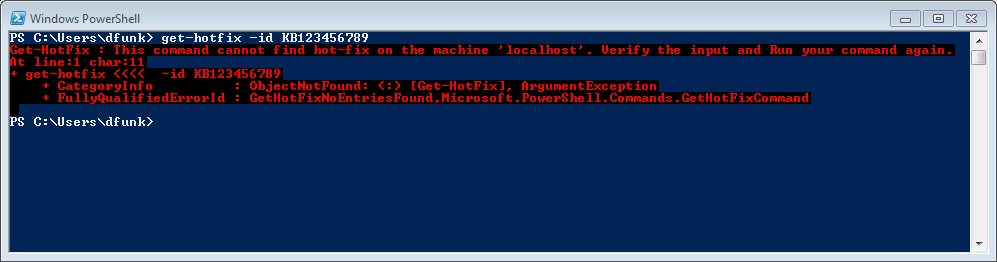
If the hotfix is not installed you will get an error.

get-hotfix-err

As easy as that.

By the way, I’m not selling these books nor do i earn commission out of their sale, but i have one of these books for pretty much every Microsoft Server/Client OS i support. They are cheap and are just full of brilliant tips such like the one i just ripped off and turned into a blog post.

Quick Fix: Outlook 2010 Sending from a second Exchange Mailbox

sbsstd

I have been battling this problem for some time now. It has been driving me to distraction it is fair to say.

Exchange

What i didn’t realise until now, is that i was actually battling two separate issues, once i realised that it made the solution clear.

The issue i was facing was that additional mailboxes were being automatically added to an Outlook profile. This was puzzling me because firstly, i didn’t know why it was happening, and secondly i OutlookLogowasn’t able to send from that second mailbox. I could manually type in the address in the From field, but i wanted to be able to choose it and have the signature change based on the account i was using.

So a lot, of research, lab work and questions later i think i found the answers, and the solution.

Issue 1. Exchange 2010 SP1 Full Mailbox Access

Are you running Exchange 2010 SP1 with clients running Outlook 2010 SP1?

If you are, and like me you have shared mailboxes, or generic mailboxes that other users access, you may be used to setting Full Mailbox access permission on those generic accounts.

Full Access

(You would then add them to Outlook through the properties of your Primary Mailbox, under More Settings, and Advanced)

With Exchange 2010 SP1 and Outlook 2010 SP1 having given full mailbox access to an account, you may have seen a that the account that you have full mailbox access to, has automatically added itself to your Outlook profile.

You may also notice, there is no way to remove it!

auto added

This behaviour is actually well documented, but one of the best explanations i found is here.

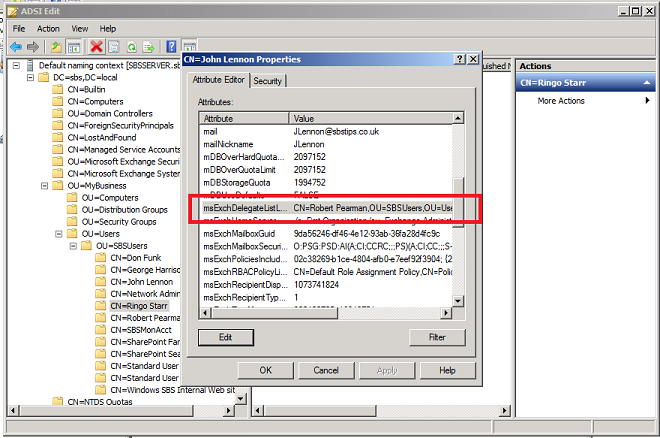
If you don’t want to bother reading that – and you should read it – basically using Exchange 2010 SP1 EMC, EMS to add Full Mailbox Access, now also sets an Attribute on the account – msExchDelegateListLink. This attribute says which other accounts have access to this mailbox.

Attribute

Outlook 2010 SP1 will look for that key now and anyone that matches, will be auto added. Quite straight forward when you know what is happening.

So that is the first part of the mystery solved.

The solution to stop this happening is easy, remove that attribute. You can either do it through ADSIEdit, or by Adding Full Mailbox Access with a script instead of using the EMC/EMS. again ill point you back to this blog for the solution.

Assuming you have now removed that attribute, you can go ahead and add the second mailbox the traditional way.


Issue 2. Outlook 2010 Send from Multiple Exchange Mailboxes

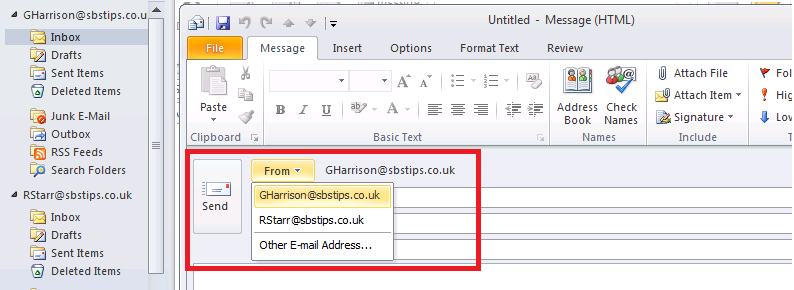
But wait – once you have done this, you still cannot select it as an account to send from?
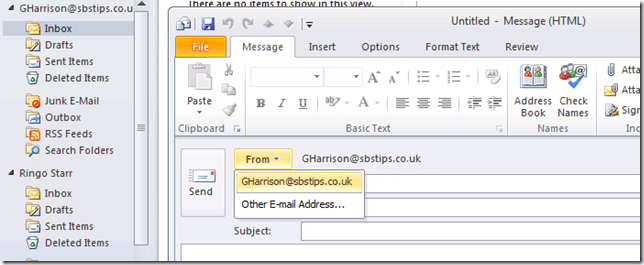
send

At this point i really started to get frustrated. I was wrongly blaming Exchange 2010 SP1 for this weird behaviour and missing the clue right under my nose.

It seems that the ability to send from a second Exchange mailbox, when it is added in what i will call, the traditional manner, has been changed in Outlook 2010.

I’m running Outlook 2010 and have several exchange mailboxes open, i just had never noticed this behaviour. I’m also running Exchange 2007, and having been dealing with the issue outlined above, i never thought to look at my own Outlook.

The solution here seems to be very simple indeed.

Once you have removed the attribute, you still retain full access. That means you can add the second mailbox, as a totally separate account, and you wont be prompted to login to that mailbox, because your current credentials have permission to open it.

So to recap, first you need to make sure you remove the msExchDelegateListLink attribute from the second mailbox. Then just add that second mailbox as a second account. You will need to close Outlook down in order to do that, when adding the mailbox choose to ‘Manually Configure Server Settings..’

manually add

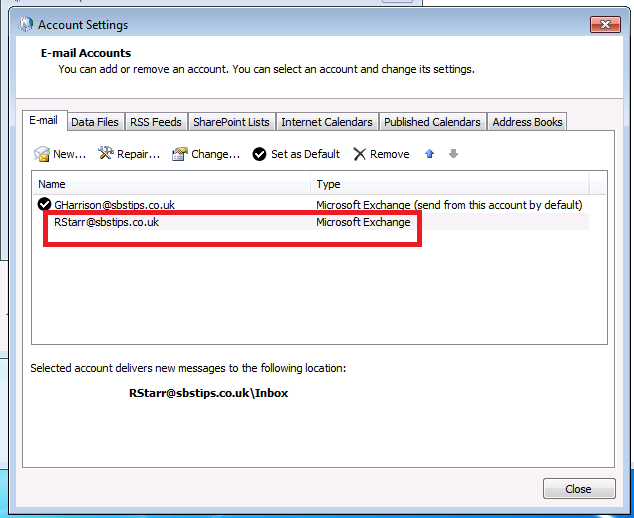
You will then see the mailbox as a second account.

second account

And you can choose to send from this account as well.
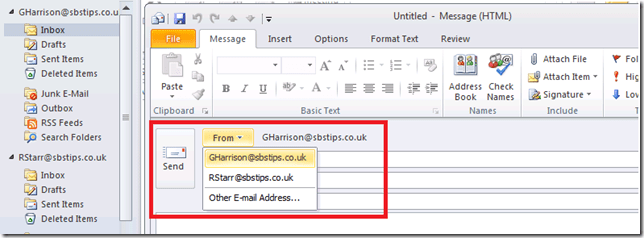
send from

I really hope this helps you, and saves you some time and energy!

Quick Fix : Find a Dell Service Tag, umm… Quickly!

Very very cool little trick this, which i picked up from Merv ‘Google Fu’ Porter (SBS MVP), no idea where he found this…  Google i suspect.

I’ve often needed to find a Dell service tag from a laptop, desktop or even a server, perhaps the best way used to be by asking a local user to look at the sticker.

Having battled with some of my users about just what a sticker actually looks like, it was time to find alternative options.

You may know you can go to the Dell Support website and run through a tool that will scan for your Service Tag, but that takes time (not really much time) but if you really, seriously, need that tag quick, and i mean yesterday, open up a command prompt and type this.

wmic csproduct get vendor,name,identifyingnumber

Service Tag

You’ll be shown your Service Tag and the Model of the Computer.

Thanks go to Merv.

SBS 2011 Standard & iPhone

sbsstdI’ve noticed a lot of people are hitting my blog with search terms like SBS2011 iPhone or words to that effect. I got to thinking that maybe some people are not interested in the technical detail in my previous posts about iPhones or iPads, and maybe they just wanted to know how to add their Exchange email to their device.

If you want to know how to configure your iPhone with Office 365 look here.

If you are looking for information on the iPhone Configuration Utility, look here.

If you are looking for information on the iPhone and AutoDiscover, look here.

If you just want me to shut up and tell you what settings you need to make your iDevice work with your new Exchange Server, read on!

Add your email to your iPhone

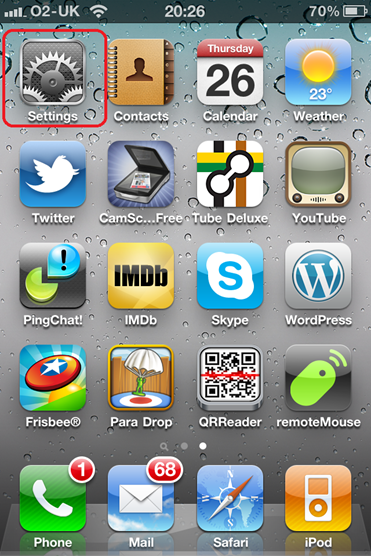
First from the Home screen, go to Settings.

iPhone home screen and settings

Then go to Mail, Contacts, Calendars

iPhone settings mail contacts calendars

Choose Add an Account.

iPhone add an account

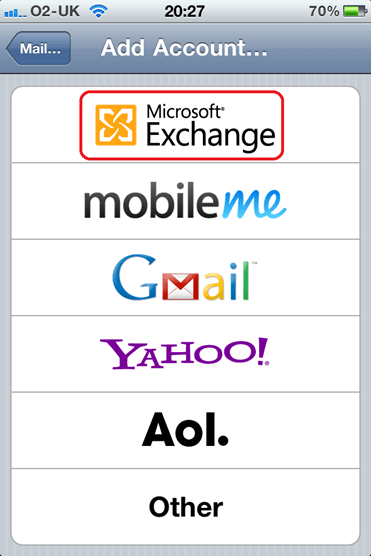
Choose Microsoft Exchange

Add Microsoft Exchange

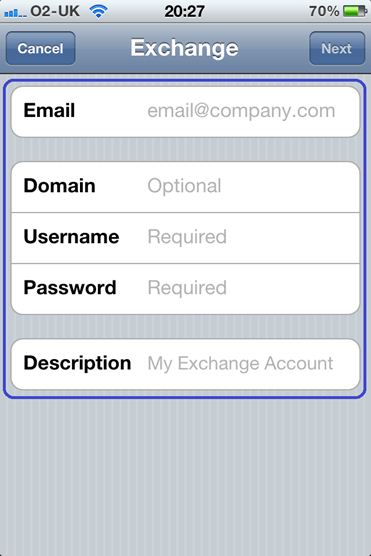
You are then asked for 5 pieces of information.

    • Email
    • Domain
    • Username
    • Password
    • Description

 iPhone exchange account details

Email

This is your email address

Domain

Your servers internal domain name. For example, ‘sbs.local’ could be your internal domain name. You can just enter ‘sbs’

Username

This is the username you use when you logon to your computer in the office.

Password

The password you use when you logon to your computer in the office.

Description

This is just a memorable name so you can distinguish between multiple email accounts on your device.

Once you have filled out this information, click on Next. Notice the device now says ‘Verifying’

iPhone Exchange email verifying account

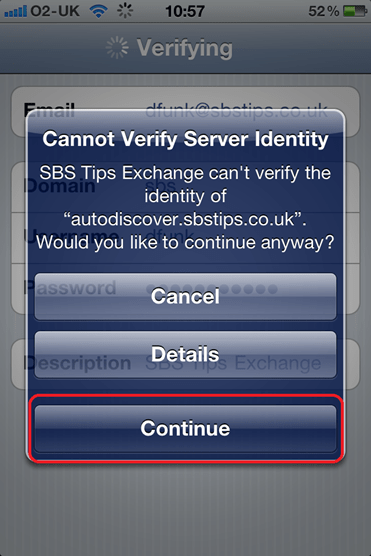
You may be presented with a warning message regarding ‘verification of the server identity’ Click on continue.

for more info on why this happens follow my link above regarding autodiscover.

iPhone Exchange Email Autodiscover

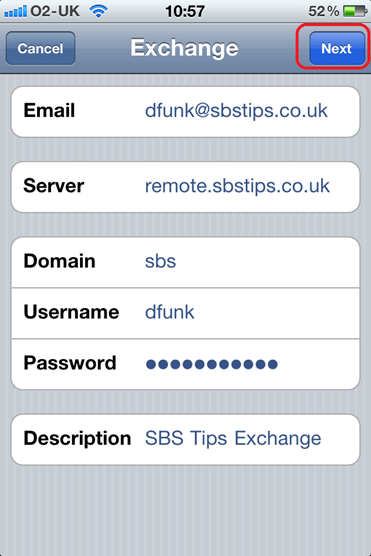
In most cases you will now see a new box appear, called Server.


Server

This is the public name for your SBS Server.

iPhone Exchange Email Server Address

The default for SBS 2008 and SBS 2011 is ‘remote.company.com’

(where company.com is your email domain)

Type this in and click next. Again the phone will show as Verifying.

iPhone Exchange Email Server Address

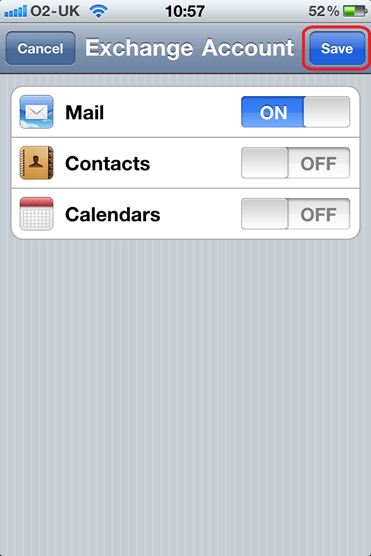
The next page will ask if you which items you want to sync to your phone.

Click on Save when you are happy with your selection.

iPhone Exchange Email choose items to sync

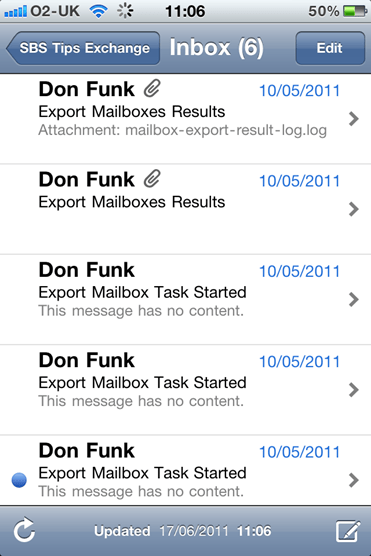
Your items will now start to sync to your phone.

iPhone Exchange Email Syncd

Default Behaviour

By default the iPhone will only sync the last 3 days of content, so don’t get freaked out if all of your email is ‘missing’.

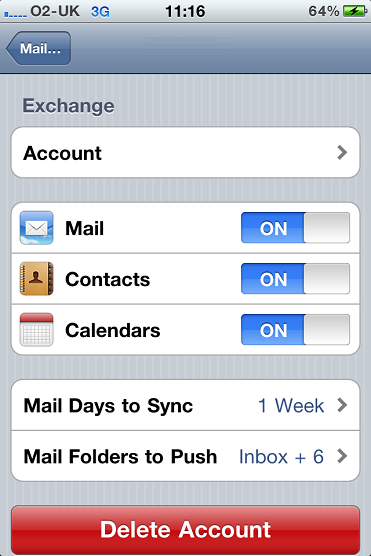
You can change the behaviour in the settings of the account.

Under, Settings, Mail, Contact, Calendars, find your account by its description. Inside here you can change the sync behaviour.

iPhone Exchange Email Account Settings